Multichannel View
Overview
When Makalu is operated as a multichannel environment, the Multichannel View is available in the Automation tab of the Makalu UI. It is a configurable view for monitoring purposes and is particularly suited for operators of multichannel environments to monitor multiple playout channels simultaneously. It is not to be confused with a multiviewer as it not only displays a preview of what is currently being played out, but also the current Rundown of each channel. Additionally, it provides access to the detailed view of each channel (see the section Detailed Channel View).
It displays channels as tiles, and each tile can be displayed either expanded or collapsed. When all channels are displayed collapsed, up to ten channels can be displayed simultaneously on a monitor with a resolution of 1920 × 1080 pixels. Which channels are available depends on the access permissions of the current user.
The channel preview initially only shows a thumbnail image of the current output of each channel to minimize data usage, especially in environments with many channels. This thumbnail image is automatically updated at a configurable interval. The actual preview playback can be started, paused, and resumed manually per channel by clicking the Play or Pause icon in the preview player area.
The Multichannel View consists of the following elements:
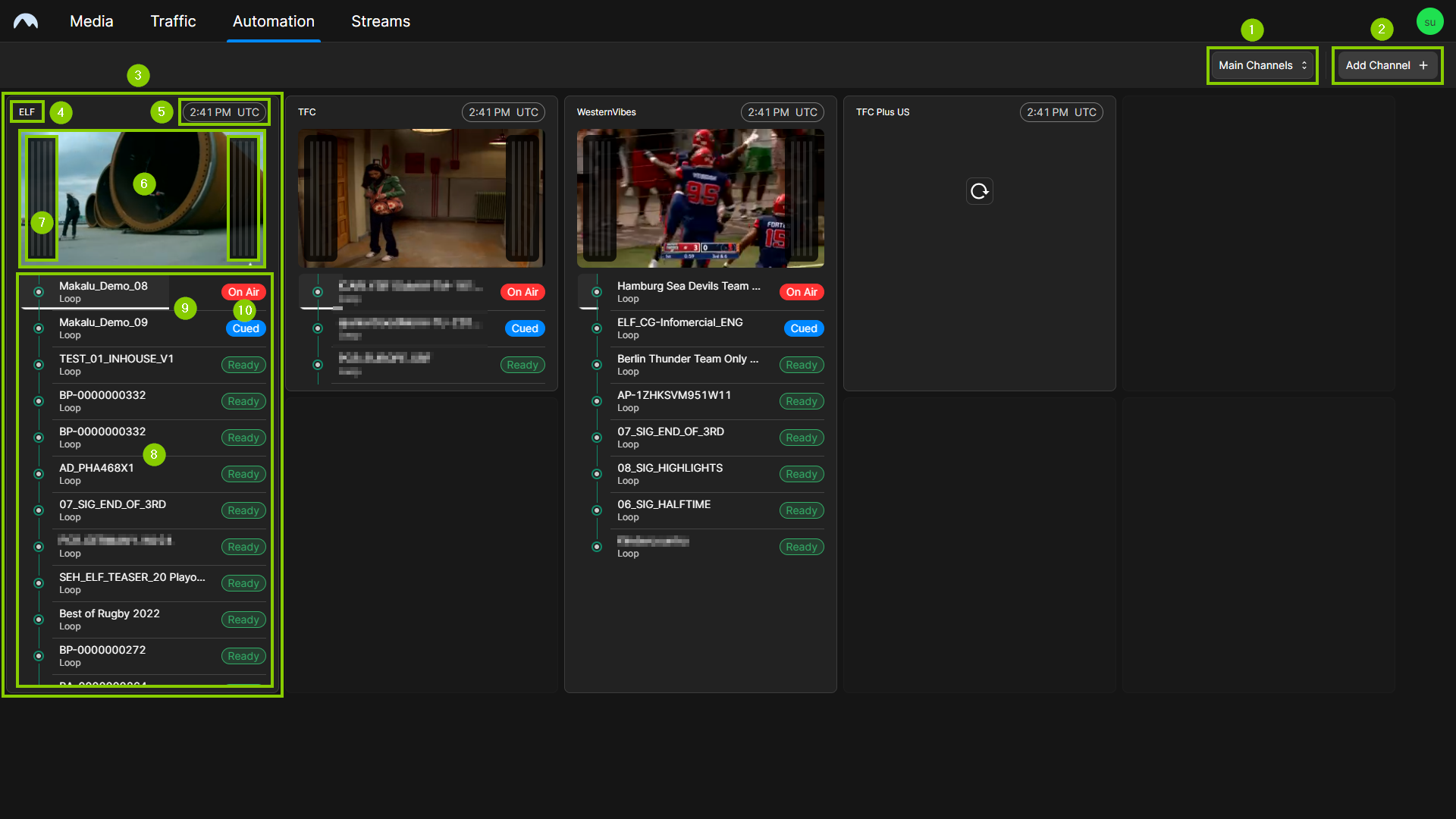
- Makalu UI main navigation
- User menu
- Track View switch
- Channel selection menu
- Channel tile
- Channel name
- Main/Backup switch (to switch between the preview output of the main or backup player of the corresponding channel)
- Local UTC time of the channel
- Channel output preview
- Rundown (starting with the clip currently being played and followed by the next clips scheduled in the Rundown, also across shows)
- Playback progress of the clip currently being played
- Clip status (for an overview of all available statuses, see the section Channel Rundown)
Makalu UI main navigation
Via the main navigation, you can access all functional areas of Makalu at any time by clicking the corresponding tab.
Tip
You can also return to the Makalu Hub by clicking the Makalu logo at the top left.
User menu
The user menu provides access to the following user- and system-related options:
| Option | Purpose |
|---|---|
| Build | Displays the build/version number of the Makalu UI |
| Open the documentation | Open the Makalu user manual |
| Reset local storage | Reset local browser storage (only relevant for development purposes) |
| Copy API Token | Copy an API token to the clipboard (only relevant for development purposes) |
| Logout | Log the current user out of the Makalu system |
Track View

The Track View provides an overview of the scheduled playlists and shows of all currently selected channels, based on their planned start time and planned duration. It allows you to see what is scheduled to play at a given time across all channels without having to open each channel individually, which is helpful when monitoring a large number of channels at once.
To open and close the Track View, click the Track View icon  at the top right of the Multichannel View.
The Track View displays one row per channel, in the same order as the channel tiles in the Multichannel View. Each row shows a channel output preview on the left, followed by a timeline that displays the scheduled playlists or shows as blocks, positioned and sized according to their planned start time and planned duration. The time display on the left is based on the local time zone of each channel while the Track View displays your local time.
You can switch the timeline between displaying playlists and shows via the Shows button  .
.
There is also an Overview bar that displays all scheduled playlists or shows of the selected day as colored lines above the timeline instead of individual blocks, which keeps the display compact in environments with a large number of channels. You can enable and disable the Overview display via the Overview icon  .
.
To navigate the Track View:
- To move between days, use the day selection at the top left of the Track View. You can also scroll past the end of the currently displayed day to move directly to the next day.
- To zoom in or out of the timeline, use the Zoom controls:
 /
/  .
. - To jump directly to a specific playlist or show when the Overview bar is enabled, click the corresponding colored bar at the top of the Track View.
Customizing the channel selection
To customize the selection:
-
Click Add Channel at the top right.
The list of available Channels is displayed.
-
In the Channels list, select the channels to be displayed.
Tip
You can search for specific channels by using the Search menu above the list.
-
To confirm your selection, click Apply.
The selection is saved. All selected channels are displayed as tiles in the Multichannel View.
Customizing a channel tile
You can customize the display of the tiles, by enabling or disabling the Rundown and audio level peak meter. Additionally, you can display the Rundown either collapsed or expanded.
To customize a channel tile:
-
Open the Multichannel View as described in section Accessing the Multichannel View.
-
Select the channel tile you want to customize.
The tile is highlighted with a white border.
-
To expand or collapse the channel Rundown display, click the Expand/Collapse icon
 at the bottom right corner of the tile.
 -
To edit the display settings, click the Settings icon
 at the bottom center of the screen.
A settings menu is displayed that enables you to show or hide the Rundown and audio level peak meter.
-
In the settings menu, select the elements to be displayed and deselect the elements to hide.
The tile display is updated based on the selected elements.